Available in Spanish
Overview
Since taking office, the Trump administration has taken away legal immigration status, protections, and work authorization from hundreds of thousands of immigrant workers (we refer to this process as “de-documenting” employees). Across industries and geographies, the administration’s immigration policies have impacted workers with various temporary statuses, including those who have humanitarian parole, deferred action, and Temporary Protected Status (TPS). Despite the significant harm this has already caused to communities and workplaces, the administration seems ready to continue to remove legal protections from hundreds of thousands more workers. This rampant de-documenting effort coincides with an unprecedented increase in immigration enforcement against immigrant employees and families, including undocumented workers.
About These FAQs
This Frequently Asked Questions (FAQ) document covers employment-related issues faced by employees who will lose, or have recently lost, work authorization. In this moment of unprecedented attacks, we hope that this FAQ helps educate advocates, organizers, and attorneys so they can support and advocate for impacted immigrant employees.
In this FAQ, we use the term “work authorization” to mean legal permission to work in the United States. We use the term “immigrant” to mean migrants, individuals with immigrant and nonimmigrant statuses under U.S. immigration law, and undocumented individuals.
This document does not address all questions related to eligibility for work authorization under immigration law or the process for requesting work permits—for those questions, we recommend consulting resources here and here. Workers who are union members may have additional rights under collective bargaining agreements (see Question 21). We encourage union members, organizers, and attorneys to contact their unions directly for more information.
Lastly, this document does not constitute legal advice, and it reflects information that is accurate as of the date of publication. Readers should contact an immigration and/or labor and employment attorney for legal advice relevant to their particular situation.
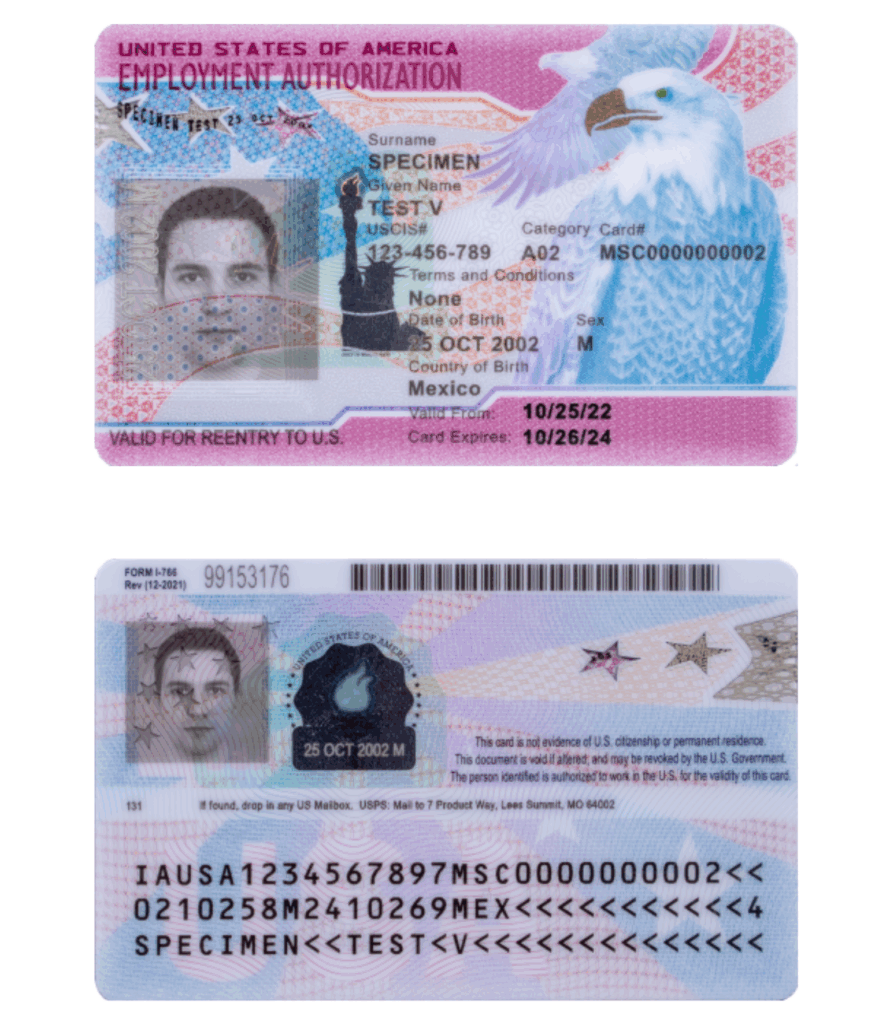
Example of a work permit, or Employment Authorization Document (EAD), front and back:
Frequently Asked Questions
Acknowledgements
Many thanks to the many partner organizations that reviewed and provided essential feedback on this FAQ, including: Ann Garcia (National Immigration Project), Chris L. Hart, Esq., Esther Sung and Laura Flores-Perilla (Justice Action Center), Monica Guizar (Service Employees International Union), Yael Schacher (Refugees International), and the staff of the Asylum Seeker Advocacy Project (ASAP).
Related to
About the Authors

Emily Tulli
Emily Tulli is a former Biden-Harris appointee to the U.S. Department of Labor, an attorney, and a consultant.
Emily Tulli es exfuncionaria nombrada por la administración Biden-Harris en el Departamento de Trabajo de Estados Unidos, abogada y consultora.

Marisa Díaz
Areas of expertise:
- Immigrants & Work,
- Workplace Equity
Marisa Díaz is the Immigrant Worker Justice Program Director with the National Employment Law Project.
Marisa Díaz es directora del Programa de Justicia para Trabajadores Inmigrantes del National Employment Law Project.
Jessie Hahn
Jessie Hahn is Senior Counsel, Labor & Employment Policy with the National Immigration Law Center.
Jessie Hahn es asesora principal de políticas laborales y de empleo en el National Immigration Law Center.
Sarah Krieger
Sarah Krieger is Senior Policy Counsel with the National Immigration Law Center.
Sarah Krieger es asesora principal de políticas en el National Immigration Law Center.
Related Resources
All resourcesHow States and Localities Can Strengthen Workplace Protections for Immigrant Workers

Policy & Data Brief
Comprender sus derechos cuando se pierde la autorización para trabajar: preguntas frecuentes para trabajadores inmigrantes y defensores

Fact Sheet
NELP’s New York City Worker Justice Agenda

Policy & Data Brief