During a packed week of Washington events—from the Congressional Black Caucus’ and Congressional Hispanic Caucus’ annual conventions to a bipartisan high-level summit on AI’s threat to humanity—NELP convened a select group of senior labor policy leaders and activists to discuss the future of worker justice in the United States.
The forward-looking policy conversation was sparked by testimonials from long-time NELP partners describing the organization’s legacy of leadership in the workers’ rights movement. Stirring remarks by Alan Barber (Roosevelt Institute), Jaribu Hill (Mississippi Workers’ Center for Human Rights), Angela Hanks (The Century Foundation), MB Maxwell (Workshop), and Kevin Reilly (Laborers’ International Union) set the stage for NELP leaders and policy experts to elucidate a winning policy perspective at a time of great promise and great peril for workers.
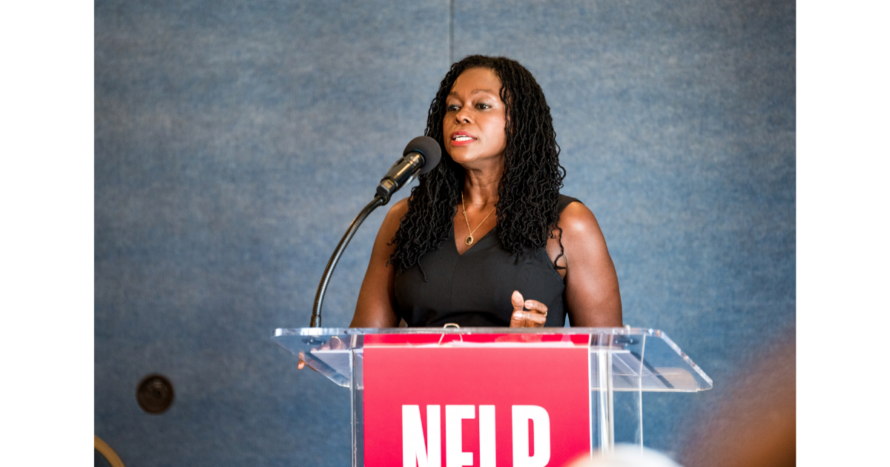
“We are once again living through a period when the rules are being rewritten,” said NELP President and CEO Rebecca Dixon, reflecting on how NELP’s groundbreaking litigation on employment discrimination nearly fifty years ago affected her own experience as a young civil service worker in Mississippi. “We must collectively keep organizing, building, and fighting—we must refuse to accept the world we inherited is the best we can do.”
In NELP’s first major in-person policy event since the COVID-19 pandemic, Dixon and speakers challenged the assembled representatives of labor unions, worker centers, and progressive research and economic policy institutes to take a hard look at the current labor rights landscape and work together to develop and fight for new policy solutions that improve workers’ lives.
“We’re facing existential threats to our bedrock worker protections—some of which workers have relied upon for nearly a hundred years,” said Raj Nayak, chair of NELP’s Board of Directors as he opened the event. “Over the course of its history, when economic crises and insecurity have threatened the stability of working families, NELP has always been the first to step up.”
In a panel discussion featuring NELP’s senior policy fellows, Teresa Acuña, NELP Visiting Fellow for Good Jobs Democracy, turned to Michele Evermore, Rob Asaro-Angelo, and Paul Sonn for their solutions, noting that the world of work is changing too quickly for our existing worker protection institutions to keep up. “We’re talking today about the future of worker justice at a moment when work itself is changing rapidly,” Acuña said. “AI, automation, contract work, and rising costs are creating new challenges, but they also give us an opportunity to rethink what workers need to thrive.”
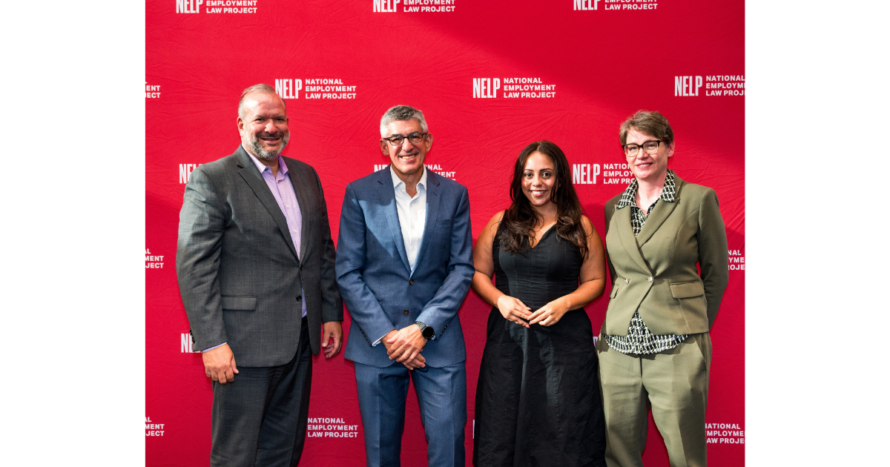
Focusing on NELP’s three principal policy areas—worker transitions, worker protections, and wages and affordability—the fellows proposed reforms to unemployment insurance (UI), minimum wages, and labor law enforcement practices.
Asserting that the current UI system is “garbage,” Evermore argued that too many unemployed people never even apply because benefits pay far too little in most states, fail to keep pace with inflation, and run out before people land their next job. At the same time, she said workers are facing an increasingly uncertain labor market, where up to a third of job postings are fake and meaningful reemployment assistance is lacking. She called for reforming the overly complicated UI system in a way that makes sense to people who don’t specialize in it, emphasizing the role unions can play in reaching unemployed workers and new ways for neighbors to help one another navigate the system.
Sonn focused on another challenge: the current affordability debate is focused heavily on lowering costs, with too little attention to raising wages. “Working families are being squeezed between rising living costs and stagnant pay,” he said. He noted that advocates have yet to coalesce around the next big wage campaign after the successful Fight for $15, suggesting that the next fight needs to go beyond the minimum wage. A renewed movement could develop a new, ambitious wage demand while also exploring sector-based wage standards that raise pay for workers in particular industries.
Finally, Asaro-Angelo drew on his recent eight years serving as New Jersey’s Labor Commissioner to argue that states can do a better job enforcing labor law even under the pressure of constrained budgets. Citing a recent study from Rutgers University that underscored the importance of effective enforcement practices in addition to strong statutory authority, Asaro-Angelo highlighted opportunities for states to innovate, particularly through stronger enforcement partnerships, more user-friendly systems for receiving worker claims, and strategies that leverage public procurement to set a high bar for employers.
The panel closed with a recognition that modernizing unemployment insurance, raising wages, and strengthening enforcement will require sustained organizing, policy innovation, and collaboration. It’s clear the attendees are eager to step up.


